


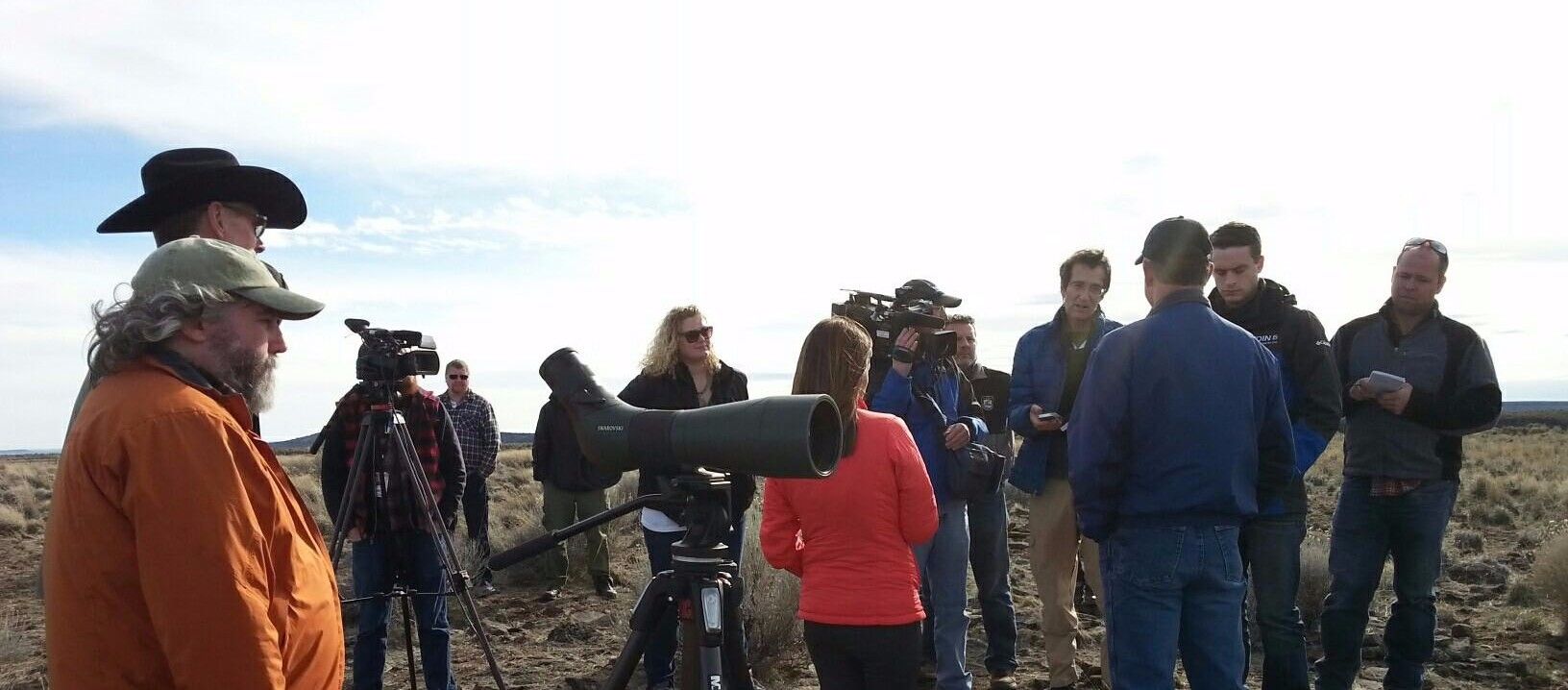
A record low snowpack for the Harney Basin has locals and agency managers worried about the potential for wildfire this summer. In fact, the wildfire season got an early start in April with the Swamp Fire on the Malheur National Wildlife Refuge.
The fire started on April 14 and burned 257 acres. Joe Sullivan, Assistant Fire Management Officer with the Bureau of Land Management Burns District, said the tulles and cattails provided the main fuel source for the fire, and this time of year that kind of vegetation can be more likely to ignite. He said the fire burned in the tulles and made a run with the wind before agencies knocked it down. Aaron Johnston, Forest and Range Collaborative Coordinator with the High Desert Partnership, noted that the amount of moisture the basin has received this year is close to or just below normal. “The issue that we've had is that our precipitation this year has come almost exclusively as rain,” he said. When precipitation falls as snow and collects in the higher elevations, it provides moisture to the lower elevations as it melts off in the warmer months. Rancher and North Harney Rangeland Fire Protection Association Chairman Tom Sharp noted, “We don't have the snowpack to sustain the normal runoffs that would supply the surface water in the creeks and the river or diverted into the meadows.” With no melt off, everything will dry out much faster, making it easier for ignitions to start when thunderstorms hit. “I've been out and looking at range conditions, and it actually looks pretty good right now. But without having the snowpack to continue the runoff and without regular rains, I think we're going to have a very challenging wildfire year,” Sharp said.
Preparing for the Season
Sullivan said the Bureau of Land Management is busy hiring and training personnel in preparation for the upcoming wildfire season. “We have a decent number of captains, and we’ve got good young permanents up and coming, and then we still have a lot of good older individuals with great local knowledge,” Sullivan said. Pictured: A past prescribed burn in the Pueblo Mountains. Photo by Jeremy Hill. Johnston noted that a lot of work done through Harney County Wildfire Collaborative and Harney County Forest Restoration Collaborative has served to reduce the fuel load on the landscape. “A lot of our thinning projects that are going on up in the forest and a lot of our fuel break implementation that we're doing out on the range is all geared toward how we can be the most efficient with the resources that we have and how we can prep the landscape ahead of time for fire,” he said.
Sullivan added that the BLM has conducted strategic fuel treatments in the Stinkingwaters, Radar Hill and Hines logging road areas to try to mitigate wildfires and help fire fighters be able to safely engage them. He noted that prescribed burns can make people nervous, especially when they flare up and turn into wildfires like the recent Pine Mountain prescribed burn near Bend. However, he noted that a lot of planning goes into these projects. “I would rather burn it on our terms in the shoulder seasons, than Mother Nature's terms in August,” he said. Sharp said that North Harney RFPA has made a couple of key purchases for this year’s wildfire season. “We need the ability to haul water rather than draft water out of creeks or water holes,” he said. “This summer we're putting into service two new pieces of equipment. One will be a water tender, a big water tank that can deliver water to the scene of action. The other will be a water trailer that can be hooked up and pulled behind anybody's pickup truck.” They have also added some chainsaw equipment capability to three of their engines so that when they respond to rangeland fires near the forest boundary, they can clear trails where blowdown has occurred. Pictured: One of two tenders Coos Forest Protective Association generously donated to RFPAs in 2024. Sharp is also a rancher, and as waterholes and creeks dry up this year, he’s making sure solar powered wells and troughs are in working order. He’s also using cows to mitigate wildfire. “I like to use cattle to thin out the fuel loading,” he said. “Grazing cattle is a good tool to use out on rangelands.”
National Transition
In January, the U.S. Department of the Interior announced it would be launching the U.S. Wildland Fire Service to manage wildfire suppression, fuels management and post-fire recovery efforts across Interior-administered and tribal lands. Essentially, it reorganizes wildland fire management across the Bureau of Indian Affairs, Bureau of Land Management, National Park Service, Office of Aviation Services, Office of Wildland Fire, and U.S. Fish and Wildlife Service to unify a coordinated response. “There’s a lot we’re still trying to figure out,” Sullivan said. “I truly do think once they get up and rolling that it will be a good thing for us to align so that we have the same qualifications needed for certain positions. I think it will just streamline some things.” Sharp said there are some unknowns about how the reorganization will be implemented. “We hope that necessary fire suppression equipment and crews will be maintained here in Harney County,” he said. “Having the ability to provide effective and quick initial response to a fire is what we want to maintain in our abilities here in Harney County so that they don't get out of hand and become huge.” Sullivan stated that his focus will be on this area and supporting partners locally. “Here in Burns, we're trying not to let much of that outside noise affect us.Our priority is making sure our team is fully prepared for the upcoming season. We’re putting a bunch of effort into getting our firefighters ready so we are able to respond quickly and effectively to wildfires on the landscape. Burns Interagency Fire Zone is committed to working alongside and supporting when needed our cooperators, neighboring agencies, and local communities.” he said.
Johnston said that the partnerships that have been established through the wildfire and forest restoration collaboratives over the last decade have really helped to provide connections between private landowners and federal and state agencies. “Those relationships are really key for getting work done on the landscape,” he said. “When we see summers ahead of us like we might have this year with some of the uncertainty that is outside of our control, whether it be with our agencies, whether it be reorganization, whether it be the weather, having those partnerships and coordination locally makes us more resilient.”
