

Collaboration can come in many forms. For the Harney Basin Wetlands Collaborative (HBWC), collaboration comes all year long. Josey Wilson, Harney Basin Ecological Coordinator, recently gave a presentation highlighting the work done by HBWC over the last year.
She said it started last January, with a metaphor in which she baked 40 mini loaves of sourdough bread for the collaborative’s monthly meeting. It served to illustrate how each partner involved in the collaborative brings unique ingredients to the table. “Through thoughtful collaboration, we can create solutions that sustain the community and the landscape. It felt like a meaningful opportunity to come together, share time, and break bread together." Wilson said.
Emergency flood restoration projects
From there, the year started off with a bang as severe flooding overtook the basin in the spring. In response to the flooding, the Emergency Flood Infrastructure Restoration Project was established utilizing cost savings generated from an irrigation project funded through a legislative bill awarded to HBWC. The Soil and Water Conservation District approached HBWC to explore whether the funds could be reallocated to an emergency program to assist irrigators with culvert upgrades and repairs to roads and dikes damaged by flooding. The collaborative agreed it would be an effective use of the funding. “This effort was especially significant because it repaired flood irrigation infrastructure damage during the floods and provided funding for 31 restoration projects for landowners throughout the basin,” Wilson said.
Boon to wildlife
The flooding created challenges for landowners and homeowners but also served as a boon to wildlife as the wet meadows received plenty of flood irrigation. Wilson said this was her second year with the collaborative, and Malheur Lake looked very different than the previous year. “The size of the lake changed drastically,” she said. “The lake was 39,119 acres before, compared to June of this year when the lake was 66,539 acres. It provided valuable habitat for migratory birds, an especially exciting outcome.”
ADCP project
The HBWC also fostered work completed by University of Oregon graduate Sarah Weber, who conducted field work on the Donner und Blitzen River as part of her thesis that involved “Quantifying the Impact of Water Management on Streamflow and Sediment in the Donner und Blitzen River within Malheur National Wildlife Refuge.” She used a piece of equipment called the Acoustic Doppler Current Profiler (ADCP) to gather data, calculate streamflow, and assess other channel characteristics of the river. “She presented her findings to the collaborative in March. We were very proud of Sarah and all the work she put into the project,” Wilson said. The collaborative has hosted a workshop on how others can use the ADCP to collect water data and would like to hold another training this year.
Award Presented
In 2023, the HBWC was awarded the Intermountain West Joint Venture Conservation Partnership Award. However, weather and cancelled flights, the actual award didn’t make its way to the partnership until 2025. At the June HBWC meeting, the award was officially presented to the collaborative.
Water Conveyance and Dispersal Management Program
Another significant project that continued in 2025 was the Water Conveyance and Dispersal Management Program, which helps landowners clean and clear ditches for better water management. Projects included sediment removal, ditch bottom elevation measurement, fixing ditch dimensions, fixing blowouts as well as cleaning out vegetation. In total, 13 landowners applied for the program, and five landowners have been contracted for implementation. “It’s significant for landowners to move water efficiently across the landscape within the basin,” Wilson said.
Site visits
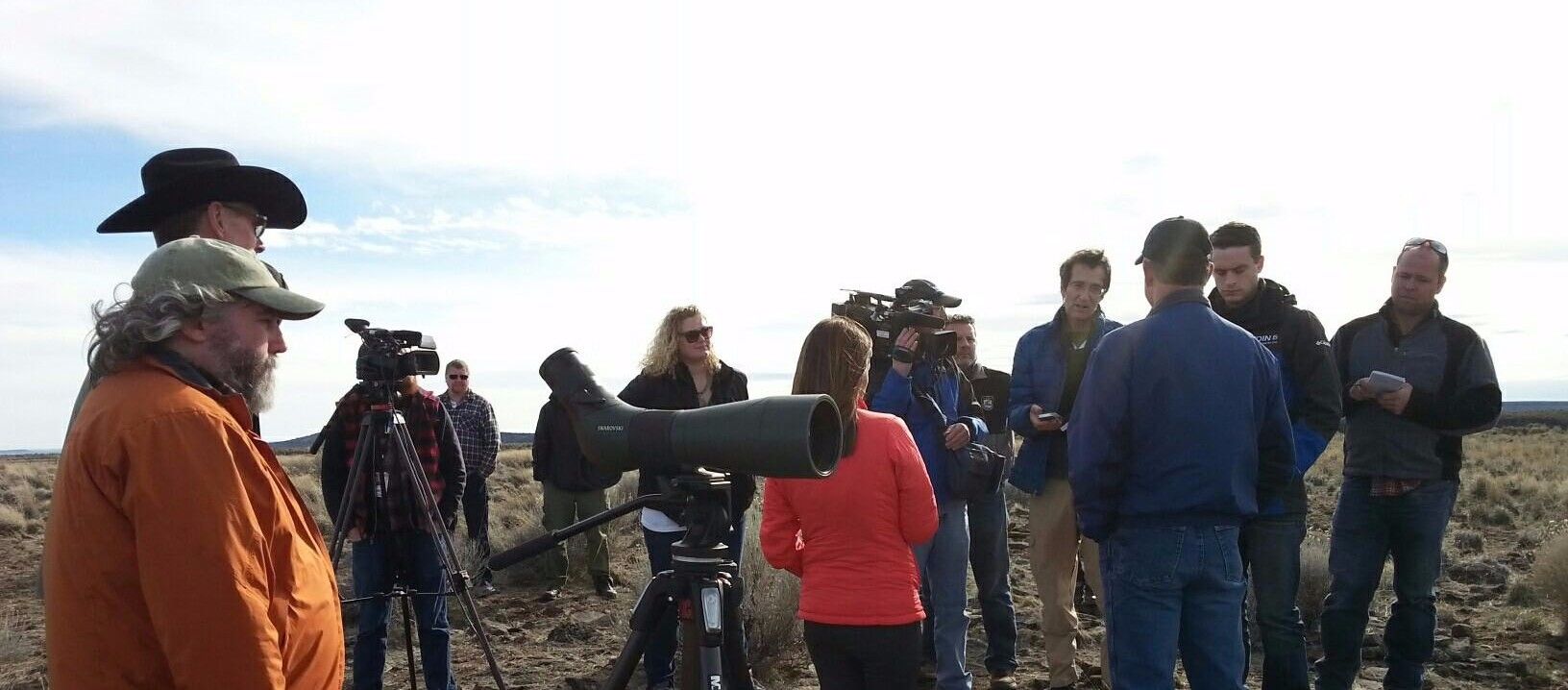
Wilson noted that summer was spent together in the field, and the HBWC held site visits to the Shelman Ranch, the Foreman Ranch, and the Baker Ranch to see how projects have improved operation on the ground for these working ranches. There were also visits to the Malheur National Wildlife Refuge to see how projects are progressing to control invasive species such as reed canary grass, hybrid cattail and smooth brome. “These efforts are helping to improve wetland resilience in ways that support both wildlife and agriculture, so it’s really valuable to see these sites in person and talk about it in real time,” Wilson said.
‘The Harney Way’
In September, the collaborative held a screening of “The Harney Way,” a 30-minute documentary showcasing how collaboration in the Harney Basin preserves vital wetlands while supporting agriculture, wildlife and the local economy. It was produced by the collaborative’s Wet Meadow Partners Esther Lev and Tony Svejcar. The screening was held at the Desert Historic Theatre, and Harney County Commissioner Rob Frank introduced the film, while filmmaker Lev highlighted the film’s purpose. “The turnout was great, and everybody really seemed to enjoy the film,” Wilson said.
FIP projects
The Oregon Watershed Enhancement Board funds many Harney Basin Wetlands Collaborative projects through the Focused Investment Partnership. “These projects within the collaborative prioritize reducing invasive species, replacing infrastructure, reconnecting our floodplain and supporting wetland habitat across the basin,” Wilson said. “It has required significant time and dedication from our partners, and I want to acknowledge and thank them for all their hard work. We are looking forward to all the projects we have planned for the coming year,” Wilson said.
Challenges
In 2024, the Burns-Hines community experienced catastrophic wildfires while the spring of 2025 was dominated by flooding. However, through it all, Wilson has seen people come together and help one another. “This community is probably one of the most resilient communities I’ve ever been a part of,” she said. In 2025, in addition to the flooding, government furloughs also created challenges for wetlands projects. There were times when partners were unable to visit the refuge making it a struggle to access projects that were in progress, Wilson noted. However, when one partner was unavailable, others stepped in to help move projects forward. “We just keep moving forward. I don’t think anything can stop us. I feel like we’re always pivoting, and we’re very flexible,” Wilson said of the Harney Basin Wetlands Collaborative.
Behind the scenes
Within the collaborative, Wilson said that a lot of work gets done behind the scenes. Such work can include trout tagging with the Oregon Department of Fish and Wildlife, checking water sondes via airboats on Malheur Lake, and duck banding at the refuge. There are also countless hours of project planning, conversations with landowners, site visits to assess irrigation infrastructure and many hours that partners spend writing and refining grants, papers and reports. Wilson acknowledges all that hard work and notes that it is crucial to the success of the collaborative and its projects.
The year ahead
One project on the horizon for the HBWC this year involves virtual fencing, a livestock management technology that uses GPS-enabled collars and audio or vibration cues to guide cattle within designated boundaries—allowing ranchers to control grazing areas without constructing physical fences. "This is a significant opportunity for landowners in the basin to incorporate the technology into their operations and use it to manage invasive species," Wilson said. “It can also be also very cost effective.”
She noted that there aren’t very many landowners who are aware of it at this point, but the collaborative hopes to change that over the next year. “We would like to hold some workshops or presentations that explain what virtual fencing is and how to use it,” she said.
Continuing with what works
Wilson said the collaborative will also continue forging ahead with existing projects that improve wet meadow habitat and flood irrigation infrastructure as well as projects that combat invasive species. “This collaborative exists and thrives because of each and every one of our partners and the passion they bring to the basin,” she said. “The time and heart and energy they dedicate to this work is living proof that collaboration truly works, and we can make a lasting difference when we choose to work together.”
